
Disclaimer: LogicHelm is reader-supported. If you purchase through links on our site, we may earn a small affiliate commission at no extra cost to you.
The 2026 AI Model Comparison for Teams That Actually Need Results
Most companies are still asking the wrong question.
They ask, “Which AI model is smartest?” when the real question is, “Which model is best for the job I need done today?”
That shift matters. In 2026, the winning teams are not using AI as a novelty chatbot or a faster search box. They are using it as a stack of specialized workers: one model for coding, one for long-context research, one for polished writing, and one for cost-efficient scale.
That is why this comparison is not a fan club ranking. It is a practical field guide for people who care about shipping work, controlling spend, and avoiding model roulette.
The short answer
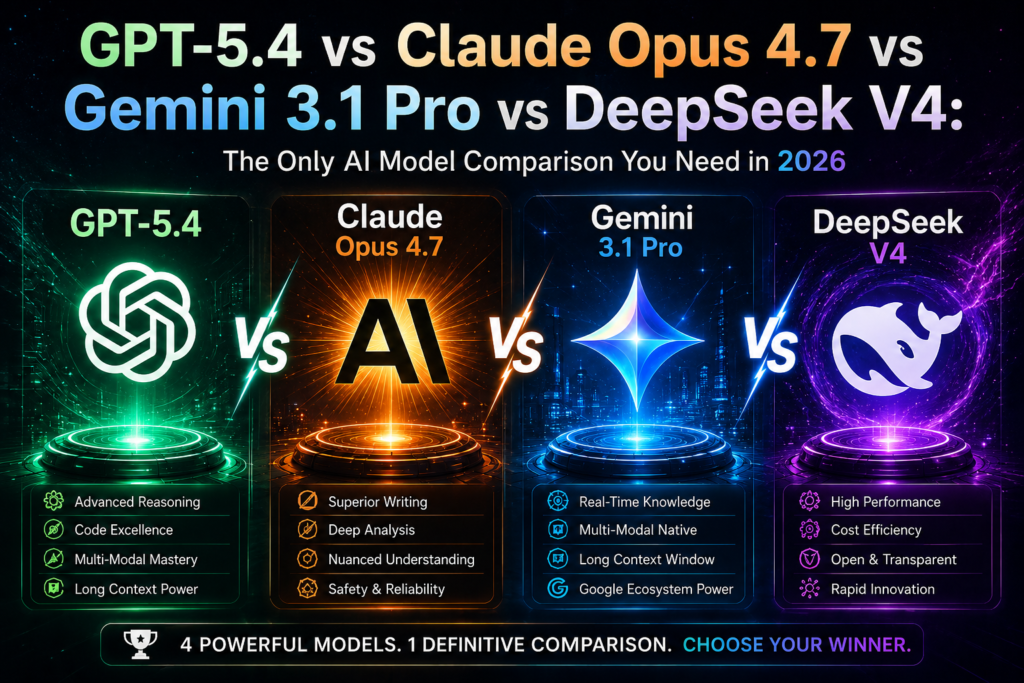
If you need the most reliable all-purpose model for coding and professional work, GPT-5.4 is a strong default. OpenAI lists it as a 1.05M-context model with pricing at $2.50 per 1M input tokens and $15 per 1M output tokens. (OpenAI Developers)
If you care most about writing quality, nuanced instruction following, and agentic coding, Claude Opus 4.7 is the premium choice in Anthropic’s current lineup. Anthropic lists it as its most capable generally available model for complex reasoning and agentic coding, with a 1M-token context window and pricing at $5/$25 per 1M input/output tokens. (Claude API Docs)
If your work depends on huge context windows and Google ecosystem integration, Gemini 3.1 Pro Preview is the model to watch. Google says it is rolling out across consumer and developer products, and Google AI docs list gemini-3.1-pro-preview with a 1M-token context window and pricing of $2/$12 per 1M tokens below 200k tokens, or $4/$18 above that threshold. (blog.google)
If your priority is cost efficiency at scale, DeepSeek V4 is the disruptor. DeepSeek’s official docs list DeepSeek-V4-Flash and DeepSeek-V4-Pro with 1M context and pricing that is dramatically lower than the frontier closed models, with V4-Flash at $0.14 input / $0.28 output per 1M tokens and V4-Pro at $0.435 input / $0.87 output per 1M tokens on cache miss. (DeepSeek API Docs)
The real AI shift: from chat to workflows
The biggest change in AI is not that models can talk more naturally. It is that they can now be embedded into real workflows.
That means the right model is the one that can survive the messiness of production: long prompts, tool use, versioned documents, codebases, sensitive instructions, and the need to stay coherent over many steps. Google’s current Gemini docs explicitly frame 3.1 Pro Preview as better at thinking, token efficiency, grounded factual consistency, and agentic workflows with precise tool usage and reliable multi-step execution. (Google AI for Developers)
The same idea shows up in Google Search guidance, too. Google says success in Search comes from helping people first, not from trying to game rankings, and it warns against scaled content abuse when generative AI is used to mass-produce thin pages with little value. (Google for Developers)
That is the core principle behind this article: do not pick a model because it sounds impressive. Pick it because it fits the job.
My practical ranking for most teams
1) GPT-5.4 — best overall default for professional work and coding
GPT-5.4 is the model I would put at the top for teams that need one dependable default for serious work. OpenAI positions it as a model for coding and professional tasks, and its 1.05M context window makes it viable for large documents, long instructions, and agent-style workflows. (OpenAI Developers)
The main reason to choose it is balance. It is not the cheapest option, but it is often the easiest “good enough plus reliable” choice when the task is complicated and the cost of a bad answer is high. That makes it a strong fit for product teams, software teams, and operators building internal assistants.
In practical terms, GPT-5.4 is the model you reach for when you need a draft, a code patch, a structured recommendation, or an agent that can move through a workflow without constantly losing the plot.
2) Claude Opus 4.7 — best writing quality and nuanced reasoning
Claude has a very different feel. Anthropic’s model overview describes Opus 4.7 as its most capable generally available model for complex reasoning and agentic coding, and it offers a 1M-token context window. (Claude API Docs)
That combination makes it especially attractive for work where tone matters: executive communication, policy writing, customer-facing content, strategy memos, legal-style analysis, and careful editing. It is also a strong fit when you want a model that follows detailed instructions closely and maintains a consistent voice.
The tradeoff is cost. At $5 / $25 per 1M input/output tokens, it is the most expensive of the four compared here on output. (Claude API Docs)
So the practical rule is simple: use Claude when the quality of expression and instruction fidelity matter more than raw cost.
3) Gemini 3.1 Pro Preview — best for long-context research and Google-native workflows
Gemini 3.1 Pro Preview is the most interesting model for teams living inside Google’s ecosystem. Google says the model is rolling out across the Gemini app, NotebookLM, AI Studio, Vertex AI, Gemini Enterprise, Gemini CLI, and Android Studio. It also says the model is designed to improve core reasoning and agentic workflows. (blog.google)
Its main advantage is scale. Google AI docs list it with a 1M-token context window and pricing that starts at $2/$12 per 1M tokens below 200k tokens, rising to $4/$18 above that threshold. (Google AI for Developers)
That makes Gemini especially useful for broad document synthesis, research over large corpora, Workspace-heavy teams, and use cases where grounding or Google Search integration matters. Google’s pricing page also shows grounding charges for search queries in some Gemini 3 tiers, which reinforces that Google is leaning into connected, retrieval-heavy workflows. (Google AI for Developers)
The downside is familiar to anyone who works with very large context windows: long context is powerful, but it can also tempt teams to dump too much in and hope for magic. Google’s own long-context docs and pricing structure suggest that longer prompts are a real product feature, but they still need careful prompt design and retrieval discipline. (Google AI for Developers)
4) DeepSeek V4 — best value for scale, especially coding-heavy workloads
DeepSeek is the value play. Its official docs show DeepSeek-V4-Flash and DeepSeek-V4-Pro with a 1M context length, dual thinking/non-thinking modes, tool calls, and very low per-token pricing compared with frontier closed models. (DeepSeek API Docs)
That makes DeepSeek a serious choice for high-volume code generation, internal tooling, summarization pipelines, and workloads where per-request economics matter a lot. DeepSeek’s preview release also emphasizes agentic capabilities, world knowledge, and math/STEM/coding performance, while noting open-sourced availability and 1M context as a standard feature. (DeepSeek API Docs)
The tradeoff is that adoption decisions are not purely technical. Many teams still need to consider compliance, regional hosting, procurement comfort, and data governance before moving core workloads onto any model provider. That is not a knock on DeepSeek; it is just how enterprise AI adoption works.
What most people get wrong about long context
A bigger context window does not automatically mean a smarter model.
It means the model can hold more in working memory. That is useful, but it does not remove the need for good structure. In fact, large prompts can create a false sense of control: teams paste in more data, more instructions, and more conflicting priorities, then blame the model when the output gets noisy.
The better pattern is orchestration.
Use one model to collect, clean, and shard the material. Use another to synthesize it. Use a third to polish the final result. That is not overengineering; it is how you reduce hallucinations, lower spending, and improve consistency.
The same principle is why Google Search rewards content that is helpful, reliable, and people-first, not pages that are merely long or keyword-stuffed. Quality of structure still beats volume of text. (Google for Developers)
The best model by use case
If you are building an autonomous workflow, GPT-5.4 is the safest default.
If you are writing something important, Claude Opus 4.7 is the strongest choice.
If you are synthesizing huge piles of information, Gemini 3.1 Pro Preview is the smartest long-context option.
If you are optimizing for budget at scale, DeepSeek V4 is the most aggressive cost play.
That is the real hierarchy.
Not “which model is best,” but “which model is best for this specific job, under these constraints, with this budget?”
The pricing reality
The cheapest model is not always the cheapest option.
A cheap model that forces reruns, bad outputs, manual cleanup, or human correction can cost more in the end than a premium model that gets the answer right the first time. That is why the right comparison is not just token pricing. It is the total workflow cost.
The official pricing snapshot matters here:
GPT-5.4: $2.50 input / $15 output per 1M tokens, with a 1.05M context window. (OpenAI Developers)
Claude Opus 4.7: $5 input / $25 output per 1M tokens, with a 1M context window. (Claude API Docs)
Gemini 3.1 Pro Preview: $2/$12 below 200k tokens and $4/$18 above, with a 1M context window. (Google AI for Developers)
DeepSeek V4: V4-Flash is listed at $0.14 input / $0.28 output per 1M tokens on cache miss, and V4-Pro at $0.435 input / $0.87 output per 1M tokens on cache miss, both with 1M context. (DeepSeek API Docs)
For most teams, that means the answer is not one model forever. It is a portfolio.
Final verdict
If you want one model to start with, pick GPT-5.4.
If you need the best prose and nuanced output, pick Claude Opus 4.7.
If your work is dominated by huge documents, Google tools, and workflow integration, pick Gemini 3.1 Pro Preview.
If cost efficiency is the main constraint, pick DeepSeek V4.
The teams that will win in 2026 are not the ones obsessed with model fandom. They are the ones who build a model stack, measure output quality, and route each task to the right system.
That is the real AI advantage.